Recent Posts

Showing posts with label country history. Show all posts

Sunday, January 13, 2013

Before the arrival of the Spaniards, El Salvador was inhabited by the Pipils, descendants of the Aztecs and the Toltecs of Mexico, who had arrived in the 12th cent. In 1524 Pedro de Alvarado landed and began a series of campaigns that resulted in Spanish control. With independence from Spain in 1821, it became briefly a part of the Mexican Empire of Augustín de Iturbide, and after the empire collapsed (1823) El Salvador joined the Central American Federation. El Salvador protested the dominance of Guatemala and under Francisco Morazán succeeded in having the federal capital transferred (1831) to San Salvador. After the dissolution of the federation (1839), the republic was plagued by frequent interference from the dictators of neighboring countries, notably Rafael Carrera and Justo Rufino Barrios of Guatemala and José Santos Zelaya of Nicaragua.

The primacy of coffee cultivation in the economy began in the second half of the 19th cent. Intense cultivation led to the predominance of landed proprietors, and the economy became vulnerable to fluctuations in the world market price for coffee. In 1931, Maximiliano Hernández Martínez, capitalizing on discontent caused by the collapse of coffee prices, led a coup. His dictatorship lasted until 1944, after which there was chronic political unrest.

Under the authoritarian rule of Major Oscar Osorio (1950–56) and Lt. Col. José María Lemus (1956–60) considerable economic progress was made. Lemus was overthrown by a coup, and after a confused period a junta composed of leaders of the National Conciliation party came to power in June, 1961. The junta's candidate, Lt. Col. Julio Adalberto Rivera, was elected president in 1962. He was succeeded in 1967 by Col. Fidel Sánchez Hernández.

Relations with Honduras deteriorated in the late 1960s. There was a border clash in 1967, and a four-day war broke out in July, 1969. The Salvadoran forces that had invaded Honduras were withdrawn, but not until 1992 was an agreement that largely settled the border controversy with Honduras signed. The last disputed border area was finally marked in 2006.

In the 1970s El Salvador's overpopulation, economic problems, and inequitable social system led to social and political unrest; by the end of the decade, murder and other terrorism by leftist guerrillas and especially by right-wing “death squads” had become common. In 1979, Gen. Carlos Humberto Romero, the last in a series of presidents whose elections were denounced by many as fraudulent, was overthrown by a military junta. Murders and other terrorism continued, and the unrest erupted into a full-scale civil war between the government and guerrillas of the leading opposition group, the FMLN.

In 1990, José Napoleón Duarte, a Christian Democrat, assumed the presidency under the junta and called for presidential elections, which he won in 1984. Despite his reputation as a reformer, he did not appear able to rein in the army and control the death squads. These excesses continued after the election in 1989 of President Alfredo Cristiani, leader of the right-wing ARENA party.

In 1991, however, the Cristiani government, with help from the United Nations, negotiated with the FMLN, and in Jan., 1992, a peace treaty with the rebels was signed, ending the bloody 12-year civil war that killed over 70,000 people. The FMLN demobilized and participated in the postwar 1994 elections, which resulted in the presidency of Armando Calderón Sol, the ARENA candidate. The army was apparently reined in, and terrorism and violence, by both left and right, virtually disappeared. A major program was put in place to transfer land (80% of which was concentrated in the hands of the wealthy) to former combatants. However, progress in implementing reforms and rebuilding the economy was slow, and was further hindered by a major hurricane in 1998.

The ARENA party remained in power with the election of Francisco Guillermo Flores Pérez to the presidency in 1999. In Mar., 2000, however, the FMLN won the greatest number of seats in the National Assembly, although not enough to control the legislature. Two earthquakes struck central El Salvador a month apart early in 2001, killing about a thousand people and leaving many homeless. In Mar., 2003, the FMLN again won the largest bloc of assembly seats, but failed to win a majority. The presidential elections a year later resulted in an ARENA victory; Elías Antonio “Tony” Saca received 57% of the vote. An earthquake in Jan., 2005, killed nearly 700 people. An increase in gang-related violence in 2005 led to army patrols on the country's streets. Legislative elections in Mar., 2006, gave a plurality of the seats to ARENA, but it failed to win a majority and the FMLN was a close second. The government mounted a crackdown against criminal gangs in Aug., 2006; in October it said it had uncovered an assassination plot against the president that was said to be linked to the anti-gang campaign.

El Salvador History

Friday, January 11, 2013

The Ancient Empire of the Nile

The valley of the “long river between the deserts,” with the annual floods, deposits of life-giving silt, and year-long growing season, was the seat of one of the earliest civilizations built by humankind. The antiquity of this civilization is almost staggering, and whereas the history of other lands is measured in centuries, that of ancient Egypt is measured in millennia. Much is known of the period even before the actual historic records began. Those records are abundant and, because of Egypt's dry climate, have been well preserved. Inscriptions have unlocked a wealth of information; for example, the existing fragments of the Palermo stone are engraved with the records of the kings of the first five dynasties. The great papyrus dumps offer an enormous amount of information, especially on the later periods of ancient Egyptian history.

Among the many problems encountered in Egyptology, one of the most controversial is that of dating events. The following dates have a margin of plus or minus 100 years for the time prior to 3000 B.C. Fairly precise dates are possible beginning with the Persian conquest (525 B.C.) of Egypt. The division of Egyptian history into 30 dynasties up to the time of Alexander the Great (a system worked out by Manetho) is a convenient frame upon which to hang the succession of the kings and a record of events. In the table entitled Dynasties of Ancient Egypt, the numbers of the dynasties are given in Roman numerals, and the numeral is followed by the dates of the dynasty and a notation of famous monarchs of the era (each of whom has a separate article in the encyclopedia). Since there are many gaps and periods without well-known rulers (occasionally without known rulers at all), those are given simply with dates or are combined with better-recorded periods.

The Old and Middle Kingdoms

A high culture developed early, and the Old Kingdom is notable for artistic and intellectual achievements (see Egyptian architecture; Egyptian art; Egyptian religion). From the beginning there was a concept of the divinity or quasi-divinity of the king (pharaoh), which lasted from the time that Egypt was first united (c.3200 B.C.) under one ruler until the ultimate fall of Egypt to the Romans. According to tradition, it was Menes (or Narmer) who as king of Upper Egypt conquered the rival kingdom of Lower Egypt in the Nile delta, thus forming the single kingdom of Egypt. In the unified and centralized state created by Menes, the memory of the two ancient kingdoms was preserved in formalities of administration. Trade flourished, and the kings of the I dynasty appear to have sent trading expeditions under military escort to Sinai to obtain copper. Indications show that under the II dynasty, trade existed with areas as far north as the Black Sea.

The III dynasty was one of the landmarks of Egyptian history, the time during which sun-worship, a new form of religion that later became the religion of the upper classes, was introduced. At the same time mummification and the building of stone monuments began. The kings of the IV dynasty (which may be said to begin the Old Kingdom proper) were the builders of the great pyramids at Giza. The great pyramid of Khufu is a monument not only to the king but also to the unified organization of ancient Egyptian society. The V to the VII dynasties are remarkable for their records of trading expeditions with armed escorts. Although Egypt flourished culturally and commercially during this period, it started to become less centralized and weaker politically. The priests of the sun-god at Heliopolis gained increasing power; the office of provincial rulers became hereditary, and their local influence was thereafter always a threat to the state.

In the 23d cent. B.C. the Old Kingdom, after a long and flourishing existence, fell apart. The local rulers became dominant, and the records, kept by the central government, tended to disappear. Some order was restored by the IX dynasty, but it was not until 2134 B.C. that power was again centralized, this time at Thebes. That city was to be the capital for most of the next millennium.

The Middle Kingdom, founded at the end of the XI dynasty, reached its zenith under the XII. The Pharaoh, however, was not then an absolute monarch but rather a feudal lord, and his vassals held their land in their own power. The XII dynasty advanced the border up the Nile to the Second Cataract. Order was preserved, the draining of El Faiyum was begun (adding a new and fertile province), a uniform system of writing was adopted, and civilization reached a new peak. After 214 years the XII dynasty came to an end in 1786 B.C. In the dimly known period that followed, Egypt passed for more than a century under the Hyksos (the so-called shepherd kings), who were apparently Semites from Syria. They were expelled from Egypt by Amasis I (Ahmose I), founder of the XVIII dynasty, and the New Kingdom was established.

The New Kingdom

The XVIII dynasty is the most important and the best-recorded period in Egyptian history. The local governors generally opposed both the Hyksos and the new dynasty; those who survived were now made mere administrators, their lands passing to the crown. Ancient Egypt reached its height. Its boundaries were extended into Asia, with a foreign province reaching the Euphrates (see Thutmose I). Letters known as the Tell el Amarna tablets are dated to this dynasty and furnish the details of the reigns of Amenhotep III and his son, Akhnaton. As Akhnaton neglected his rule in the pursuit of religion, letters from local rulers became increasingly urgent in begging help, especially against the Hittites. Of the rulers following Akhnaton in this dynasty, Tutankhamen is important for his law code and his enforcement of those laws through the courts. Architecture was at its zenith with the enormous and impressive buildings at and around Thebes.

Egyptian civilization seems to have worn out rapidly after conflicts with the Hittites under the XIX dynasty and with sea raiders under the XX dynasty. With a succession of weak kings, the Theban priesthood practically ruled the country and continued to maintain a sort of theocracy for 450 years. In the delta the Libyan element had been growing, and with the disappearance of the weak XXI dynasty, which had governed from Tanis, a Libyan dynasty came to power. This was succeeded by the alien rule of Nubians, black Africans who advanced from the south to the delta under Piankhi and later conquered the land. The rising power of Assyria threatened Egypt by absorbing the petty states of Syria and Palestine, and Assyrian kings had reached the borders of Egypt several times before Esar-Haddon actually invaded (673 B.C.) the land of the Nile.

Assyrian rule was, however, short-lived; by 650 B.C., under Psamtik, Egypt was once more independent and orderly. Greek traders became important, and their city of Naucratis, founded by Amasis II, thrived. Attempts to reestablish Egyptian power in Asia were turned back (605 B.C.) by the Babylonian king Nebuchadnezzar, and Egypt fell easy prey (525 B.C.) to the armies of Cambyses of Persia. Despite occasional troubles, the Persians maintained their hegemony until 405 B.C. New dynasties were then established, but they did not regain the old splendor. The Persians again became dominant in 341 B.C. Egypt, rich and ill-defended, fell to Alexander the Great without resistance in 332 B.C.

When Alexander's brief empire faded, Egypt in the wars of his successors (the Diadochi) fell to his general Ptolemy, who became king as Ptolemy I. All the succeeding kings of the dynasty were also named Ptolemy. The great city of Alexandria became the intellectual center and fountainhead of the Hellenistic world. The Ptolemies maintained a formidable empire for more than two centuries and exercised great power in the E Mediterranean. The Jewish population was large—perhaps as much as a seventh of the total population—and even the Palestinian Jews looked to the Alexandrian Jews for guidance.

The rising power of Rome soon overshadowed Egypt, but it was not until Ptolemy XI sought Roman aid through Pompey to regain his throne that Rome actually obtained (58 B.C.) a foothold in Egypt itself. Cleopatra, the daughter of Ptolemy XI, tried to win back power for Egypt, especially through Julius Caesar and Marc Antony. Octavian (later Emperor Augustus) actually annexed Egypt to Rome, putting to death Cleopatra's son, Ptolemy XIV, who was the last of the Ptolemies. Egypt became a granary for Rome; the emperors from Augustus to Hadrian raised the irrigation system to great efficiency, and Trajan reopened the ancient Nile–Red Sea canal. In the 2d cent. A.D., strife between Jews and Greeks in Alexandria brought massacres.

Christianity was welcomed in Egypt, and several of the most celebrated Doctors of the Church, notably St. Athanasius, St. Cyril of Alexandria, and Origen, were Egyptians. Egypt gave rise to the Arian and Nestorian heresies, and Gnosticism flourished there for a time. The patriarch of Alexandria was probably the most important figure in Egypt. After St. Cyril, Monophysitism became the national faith; out of this arose the Coptic Church. The hostility of the people to the Orthodox Byzantine emperors and officials probably helped Khosru II of Persia to gain Egypt in 616. It was recovered (c.628) by Heraclius I, but the Persian invasion proved to be only a forerunner of the more serious Arabian invasion.

Islamic Egypt

The Arab conquest of Egypt (639–42), only some 20 years after the rise of Islam, made the country an integral part of the Muslim world. Until the 19th cent., Egyptian history was intimately involved with the general political development of Islam, whether unified or divided into warring states. Under the Umayyad caliphate many of the people continued their adherence to Coptic Christianity despite the special tax exacted from infidels. Eventually, the settling of colonists from Arabia and the increased conversion of peoples to Islam reduced the Christian population to a small minority. The Greek and Coptic languages went out of use, and Arabic became the predominant language.

The Abbasid caliphate (founded c.750) at first held Egypt under complete subjection, but the unwieldiness of its vast domain encouraged provincial governors to revolt and to assert their own rule. In the 10th cent., Egypt fell to the Fatimid claimants to the caliphate, who invaded from the west. The Fatimids founded (969) Cairo as their capital, and with the establishment (972) there of the Mosque of Al-Azhar as a great (and still active) Muslim university, they further emphasized the change of Egypt from an outpost of Islam to one of its centers.

The strain of the Crusades and internal political disorder led to the fall of the Fatimids and to the founding by Saladin of the Ayyubid dynasty. The strategic position of Egypt made it a logical target of the Crusaders, who twice (1219–21, 1249–50) held Damietta, then the chief Mediterranean port, but could advance no farther.

The later Ayyubid rulers came excessively under the control of their slave soldiers and advisers, the Mamluks, who in 1250 seized the country. Until 1517, when Egypt was conquered by the Ottoman Turks, the Mamluks maintained their turbulent rule, with frequent revolts and extremely short tenures for most of the sultans. Nevertheless, they built many great architectural monuments. Their importance by no means disappeared with the establishment of Ottoman power, for the Egyptian pasha (governor) was compelled to consult the Mamluk beys (princes), who continued in control of the provinces.

Ottoman control had become almost nominal by the administration (1768–73) of Ali Bey, who termed himself sultan. The Ottoman Turks, however, continually attempted to assert power over the unruly beys. On the pretext of establishing order there, Napoleon Bonaparte (Napoleon I) undertook the French occupation of Egypt (1798–1801); yet his real object was to cut off British trade lines and, eventually, to detach India from the British Empire. All his efforts were bent to establishing French power in the region. The Ottoman Turks, however, ultimately joined the British in forcing out the French.

The French withdrawal was followed by the rise of Muhammad Ali, a former commander, who was appointed (1805) Egyptian pasha by the Ottoman emperor. He permanently destroyed (1811) the Mamluks' power by massacring their leaders. Using Europe as a model, Muhammad Ali laid the foundations of the modern Egyptian state. He introduced political, social, and educational reforms and developed an effective bureaucracy; he also undertook massive economic development by expanding and modernizing agriculture and by starting large-scale industry. Under his rule the empire eventually extended from Sudan in the south to Arabia in the east and Syria in the northeast. Abbas I (reigned 1848–54), Muhammad Ali's successor, undid some of his reforms and was followed by Muhammad Said Pasha.

European Domination

In 1854, Said granted Ferdinand de Lesseps a concession for the construction of the Suez Canal, a project that put Egypt into deep financial debt and robbed it of its thriving transit-trade on the Alexandria-Cairo railroad. In addition, the strategic nature of the canal, which opened in 1867, shifted Great Britain's focus in the Middle East from Constantinople to Cairo and opened the door to British intervention in Egyptian affairs. Said was followed by Khedive (viceroy) Ismail Pasha, whose rule was characterized by accelerated economic development, Westernization, and the establishment of Egyptian autonomy. The cost of Said's reforms, of the construction of the Suez Canal, and of his conquests in Africa, however, put Egypt deep into debt and forced Ismail to sell (1875) his Suez Canal shares to the British. Egypt's financial problems led to further subordination of the country to great-power interests. Ismail was forced to accept the establishment of a French-British Debt Commission.

In 1879, Ismail was compelled to abdicate in favor of his son Tewfik Pasha, who was confronted with financial and political chaos; his situation was complicated by the outbreak of a nationalist and military revolt (1881–82) under Arabi Pasha. The British reacted to the revolt with a naval bombardment of Alexandria in July, 1882, and by landing British troops, who defeated Arabi Pasha at the battle of Tell el Kabir and went on to occupy Cairo.

The British consolidated their control during the period (1883–1907) when Lord Cromer was consul general and de facto ruler. By 1904 the governments of France, Austria, and Italy agreed not to obstruct Britain in its intention to stay in Egypt indefinitely. During World War I, after Turkey joined the Central Powers, Great Britain declared Egypt a British protectorate and deposed Abbas II, the allegedly pro-German khedive, substituting Husein Kamil (1914–17), a member of his family. After the war Egyptian nationalists of the Wafd party, led by Zaghlul Pasha, were especially vigorous in their demands for freedom.

Independence

Under the rule of Ahmad Fuad (who later became Fuad I), a treaty providing for Egypt's independence was concluded (1922). It went into effect in 1923 following the proclamation of a constitution that made Egypt a kingdom under Fuad and established a parliament. Great Britain, however, retained the right to station troops in Egypt and refused to consider Egyptian claims to the Anglo-Egyptian Sudan (see Sudan). The British protectorate was maintained until the promulgation of a new treaty in 1936, which made the two countries allies and promised the eventual withdrawal of British troops. Fuad was succeeded by his son Farouk. In 1937 a further step toward sovereignty was accomplished by an agreement (which went into effect in 1949) to end extraterritoriality in Egypt.
In the postindependence years, Egypt's internal political life was largely a struggle for power between the Wafd party and the throne. The constitution was suspended in 1930, and Egypt was under a virtual royal dictatorship until the Wafdists forced the readoption of the constitution in 1935. During World War II, Egypt remained officially neutral. However, Egyptian facilities were put at the disposal of the British and several battles were fought on Egyptian soil (for details of the military engagements, see North Africa, campaigns in).

After the war, demands were made for a revision of the treaty of 1936. Repeated talks failed because of Egyptian insistence that Great Britain allow incorporation of the Anglo-Egyptian Sudan into Egypt. An Egyptian appeal (1947) on this subject to the Security Council of the United Nations was also in vain. Egypt actively opposed the UN partition of Palestine in 1948 and, joining its forces with the other members of the Arab League, sent troops into the S Negev. Israeli forces, however, repelled the Egyptians in bitter fighting (see Arab-Israeli Wars).

In domestic politics, the Wafd acquired a majority in 1950 and formed a one-party cabinet. The struggle between King Farouk and the Wafdist government intensified, and several political uprisings led to violence. On July 23, 1952, the military, headed by Gen. Muhammad Naguib, took power by coup. Farouk abdicated in favor of his infant son, Ahmad Fuad II, but in 1953 the monarchy was abolished and a republic was declared. Naguib assumed the presidency, but, in his attempts to move toward a parliamentary republic, he met with opposition from other members of the Revolutionary Command Committee (RCC). Increasing difficulties led to the extension of martial law. Col. Gamal Abdal Nasser emerged as a rival to Naguib, and in Feb., 1954, Naguib resigned.

Egypt under Nasser

Nasser took full power in Nov., 1954. Under the new constitution, he was elected president for a six-year term. The long-standing dispute over Sudan was ended on Jan. 1, 1956, when Sudan announced its independence, recognized by both Egypt and Great Britain. British troops, by previous agreement (July, 1954), completed their evacuation of the Suez Canal Zone in June, 1956. Tension increased in July, 1956, when, after the United States and Great Britain withdrew their pledges of financial aid for the building of the Aswan High Dam, the Soviet Union stepped in to finance the dam. Nasser then nationalized the Suez Canal and expelled British oil and embassy officials from Egypt.

On Oct. 29, Israel, barred from the canal and antagonized by continued guerrilla attacks from Gaza, invaded Gaza and the Sinai peninsula in joint arrangement with Britain and France, who attacked Egypt by air on Oct. 31. Within a week Great Britain, France, and Israel yielded to international political pressure, especially that of the United States, and a cease-fire was pronounced. A UN emergency force then occupied the Canal Zone in Dec., 1956. Israeli troops evacuated Egyptian territory in the spring of 1957.

In Feb., 1958, Syria and Egypt merged as the United Arab Republic. They were joined by Yemen in March, creating the United Arab States. The union was soon torn by personal and political differences, and a Syrian revolt (1961) led to its virtual dissolution.

Egypt embarked on a program of industrialization, chiefly through Soviet technical and economic aid. Both industry and agriculture were almost completely nationalized by 1962. In the early 1960s, Nasser strove to make Egypt the undisputed leader of a united Arab world; his chief and most effective rallying cry for Arab unity remained his denunciation of Israel and his call for that country's extinction. From 1962 to 1967, Egyptian forces provided the chief strength of the republican government in Yemen, where the royalists were backed by Saudi Arabia. Heavy losses finally moved Egypt to withdraw, and the republicans ultimately gained control. Egyptian military might continued to increase with the acquisition of powerful modern weapons, many of which were supplied by the USSR. In 1965 and 1966 two anti-Nasser plots were discovered and crushed. Nasser assumed near absolute control in 1967 by taking over the premiership and the leadership of the Arab Socialist Union (ASU), the country's sole political party.

In the spring of 1967, Egyptian troops were ordered to positions on the Israeli border, and Nasser demanded that the UN peacekeeping force stationed on the Egyptian side of the border since 1956 be withdrawn. Following the UN evacuation, Arab troops massed on the frontier, and Nasser announced (May 22) that the Gulf of Aqaba was closed to Israeli shipping. Other Arab states rallied to Egypt's support.

On June 5, Israel launched air and ground attacks against Arab positions and after six days achieved a rapid and decisive victory despite the Arab superiority in numbers and armaments. When the UN cease-fire went into effect, Israel held the Sinai peninsula, Gaza, and the east bank of the Suez Canal. After the war, Egypt received a massive infusion of Soviet military and economic aid in a program designed to rebuild its armed forces and economy, both shattered by the war. Egypt's postwar policy was based on two principles: no direct negotiations with Israel and the implementation of UN Security Council Resolution 242, which, in part, called for the withdrawal of Israeli armed forces from occupied territories.

After Nasser's sudden death in Sept., 1970, Vice President Anwar al-Sadat succeeded him as president. An abortive coup took place in May, 1971, but Sadat emerged in control. A new constitution was ratified in Sept., 1971, when the country changed its name to the Arab Republic of Egypt. Sadat modified somewhat Nasser's hard line toward Israel but continued to demand Israeli withdrawal from the occupied territories and threatened to renew the war in order to regain the lands. In 1972, Sadat ousted all Soviet military personnel stationed in Egypt and placed Soviet bases and equipment under Egyptian control, thus reversing a 20-year trend of increasing dependence on the USSR. Unrest in 1973 led to the forced resignation of the governmental cabinet and to Sadat's assumption of the premiership.

The 1973 War

Another war with Israel broke out on Oct. 6, 1973, when Egyptian forces attacked Israel on the Jewish holiday of Yom Kippur. Israeli forces were caught off guard as Egyptian units progressed into the Sinai, and fighting broke out between Israel and Syria on the Golan Heights. The fighting escalated both on the ground and in the air.

After Israel had stabilized the Syrian front, its troops crossed the Suez Canal and toward the end of the war were in control of some 475 sq mi (1,230 sq km) on the west bank of the canal between Ismailia and Adabiya, surrounding the city of Suez and trapping Egypt's Third Army on the east side of the canal. Sadat called for a cease-fire coupled with the withdrawal of Israel from territories it had occupied since 1967. At the same time, Arab countries, by reducing—and later stopping—oil exports to selected countries supporting Israel, put pressure on the United States to get Israel to pull back from the occupied lands.

On Oct. 22 the United States and the USSR submitted a joint resolution to the UN Security Council calling for an immediate cease-fire and the beginning of peace negotiations. The Security Council voted to establish a UN emergency force made up of troops from the smaller nations to supervise the cease-fire. Through the mediation efforts of U.S. Secretary of State Henry A. Kissinger, Egypt and Israel agreed to face-to-face negotiations on implementing the cease-fire. On Nov. 9, Israel accepted a proposal, worked out by Kissinger and Sadat.

Peace and Internal Unrest

A result of the intense U.S. effort to secure a settlement was the resumption of diplomatic relations between the United States and Egypt, which had been severed since the 1967 war. This marked the beginning of closer relations with the West. After regaining both banks of the Suez Canal as a result of the postwar agreement, Egypt, with U.S. assistance, began to clear the canal of mines and sunken ships left from the 1967 war. In 1974, following a visit to Egypt by U.S. President Richard Nixon, a treaty was signed providing U.S. aid to Egypt of nuclear technology for peaceful purposes.
In 1977, Sadat surprised the world with his visit to Jerusalem and plans for peace with Israel. On Mar. 26, 1979, Egypt signed a formal peace treaty with Israel in Washington, D.C. By 1982, Israel had withdrawn from nearly all the Sinai. Egypt was suspended from the Arab League as a result of the peace treaty. A boycott by Arab countries was imposed on Egypt, and Libya, which had cut ties with Egypt in 1977, provoked border clashes.

Domestic unrest between Muslims and Christians in 1981 led to a crackdown by the government. Tensions heightened, and Sadat was assassinated on Oct. 6, 1981, by Muslim extemists. He was succeeded by Vice President Hosni Mubarak, who faced growing economic problems as well as continued opposition from militant Muslim fundamentalists. A state of emergency, imposed after Sadat's murder, continued to be extended by Egypt's parliament into the 21st cent.
President Mubarak continued amicable relations with Israel and the United States and remained active in the Middle East peace process. In 1989, Israel returned the last portion of the Sinai that it held, the Taba Strip, to Egypt. Relations with the rest of the Arab world improved, and Egypt was readmitted into the Arab League in 1989.

In return for Egypt's anti-Iraq stance and its sending of troops in the Persian Gulf War (1991), the United States dismissed $7 billion in Egyptian debt. Participation in the war strengthened Western ties and enhanced Egypt's regional leadership role but was not popular domestically. Opposition from Islamic fundamentalists heightened during the 1990s; from 1992 to 1997, more than 1,200 people, mostly Egyptian Christians, were killed in terrorist violence. A 1997 attack on tourists visiting the Temple of Hatshepsut at Luxor claimed some 70 lives. During the same period, an estimated 26,000 Islamic militants were jailed and dozens were sentenced to death.

In 1999, Mubarak was returned to office for a fourth six-year term. Poverty is the nation's most pressing problem, but the government has failed to undertake significant economic reforms; social inequities have heightened societal tensions, and authoritarian rule has fostered corruption. Islamic militancy and terrorism, most dramatically demonstrated in recent years by the Oct., 2004, July, 2005, and Apr., 2006, bombings of several Sinai resorts, also remain challenges to Egypt's government, as do liberal reformers who have become more vocal and move visible in calling for constitutional reform.

In Feb., 2005, Mubarak called for a constitutional amendment to permit the direct election of the president from among a multiparty slate, but the restrictions in the amendment on who might run prevent the contest from being open to all challengers. After passage by parliament, the amendment was approved (May) in a referendum whose results were denounced as fraudulent by the opposition. At the same time, however, the government was trying Ayman Nour, a leading opposition figure, on charges that his lawyers claimed were fabricated in an attempt to derail his presidential candidacy. In the election in September, Mubarak was reelected and Nour placed second. Observers said that the election was marred by irregularities but also that they would not have affected the result; the turnout was only 23% of the nation's voters.

In the subsequent (November–December) parliamentary elections the government secured a more than two thirds of the seats, but candidates aligned with the Muslim Brotherhood won roughly a fifth of the seats a record number. The voting was marred by violence and intimidation that seemed clearly directed by the government at opposition voters. In Dec., 2005, Nour was convicted on charges related to the forgery of signatures on electoral petitions, which most nongovernment observers regarded as improbable, and was sentenced to prison. In 2006 there was increasingly vocal public support for establishment of a truly independent judiciary, as protestors rallied in in May support of two judges who had called for reform and faced dismissal for having criticized the presidential election. the police violently suppressed the rallies, however, and the reforms that were passed in June were widely criticized as inadequate.

In Mar., 2007, a referendum approved amendments to the constitution, earlier approved by parliament, that were generally regarded as antidemocratic (one of the amendments replaced judicial supervision of elections with an electoral committee, another banned religious-based parties). The government claimed that roughly a quarter of the electorate voted, but several independent groups estimated the turnout at roughly 5%, and they and opposition groups accused the government of vote rigging. The following month Amnesty International accused Egypt of systematic human-rights abuses and as acting as an international center for abusive interrogation and prolonged detention in the “war on terror.” Elections in June for seats in parliament's upper house, which the governing party handily won, were marred by police interference and vote rigging. Subsequently in 2007 the government launched a crackdown on the Muslim Brotherhood.

Egypt History

Wednesday, January 9, 2013


The Portuguese visited Timor in the early 16th cent. and were the first Europeans to establish themselves in Timor, at Lifau in what is now Ambeno in 1556. Their claim to the island was disputed by the Dutch, who arrived in 1613. By a treaty of 1859, modified in 1893 and finally made effective in 1914, the border between the Dutch and Portuguese territories was settled. The colonial powers exploited the island's sandalwood, which was largely exhausted by the early 1900s. In World War II, Timor was occupied (early 1942) by the Japanese. In 1950, Dutch Timor and the rest of the surrounding Dutch East Indies became the Republic of Indonesia.

In 1975, when Portugal's former colonies were being granted independence, fighting broke out between rival independence parties in Portuguese Timor. The leftist Revolutionary Front for an Independent East Timor (FRETILIN) triumphed, and on November 28th FRETILIN established the Democratic Republic of East Timor, with Francisco Xavier do Amaral as its president. Nine days later, Indonesia invaded and claimed sovereignty, administering the area as Timor Timur province, but the annexation was not accepted internationally. The population was decimated by food shortages, disease, and military violence, with perhaps as many as 120,000 people dying by 1979. Sporadic warfare with FRETILIN guerrillas continued, and in Aug., 1998, Indonesia and Portugal reached an agreement that would give East Timor the right to local self-government. Indonesia was reluctant to withdraw its forces, however, and talks broke down.

In Mar., 1999, Portugal and Indonesia agreed to let the East Timorese choose between autonomy within Indonesia or independence. Indonesia expected to win ratification of its rule, but in August, in a UN-supervised referendum, voters chose independence. The territory descended into chaos as pro-Indonesian militias and the army engaged in a campaign of terror and brutality, killing supporters of independence, looting and burning buildings, and causing thousands to flee their homes. In September, after intense international pressure, Indonesia asked the United Nations to send a peacekeeping force to East Timor. In October, the United Nations agreed to assume the administration and defense of East Timor, which became a non-self-governing territory. Although Indonesia tried some officials and security personnel in connection with the violence, all ultimately were acquitted or had their convictions overturned.

A constituent assembly, charged with writing a constitution for East Timor, was elected in Sept., 2001. In Apr., 2002, José Alexandre “Xanana” Gusmão (later known as Kay Rala Xanana Gusmão), a former guerrilla leader, defeated Xavier do Amaral for the presidency, and the following month East Timor became an independent nation. FRETILIN won a majority of seats in the parliament, and Mari Alkatiri became prime minister. An agreement resolving most border issues was signed with Indonesia in 2005; peacekeeping forces were withdrawn the same year.

Oil and gas fields in the waters between East Timor and Australia made the settlement of their ocean boundary contentious, but in an agreement signed in 2006 East Timor postponed settlement of the issue for 50 years in exchange for an increased percentage of oil and gas revenues. A report by an independent truth and reconciliation commission concerning the effects of Indonesia's occupation of East Timor, including an estimate of up to 183,000 deaths as a result of Indonesia's policies, was submitted to the United Nations in Jan., 2006, drawing protests from Indonesia and chilling relations with Jakarta.
In Feb., 2006, soldiers from W East Timor struck in protest over pay and perceived bias against them as westerners (generally regarded as more pro-Indonesian); in March some 600 soldiers were dismissed as a result. Protests by the former soldiers spiraled into rioting in April and gang violence in May, as former soldiers fought supporters of Prime Minister Alkatiri, whose resignation the soldiers demanded. Foreign peacekeepers returned to East Timor in late May, but stability was slow to be restored to the country, and some 150,000 were displaced as a result of the violence. In late June, Alkatiri, under pressure, finally agreed to resign, but the situation remained somewhat unsettled, and there was concern over possible long-term tensions between W and E Timorese.
José Ramos-Horta, the former foreign minister and co-winner of the 1996 Nobel Peace Prize, was appointed prime minister in July. In 2007 presidential election, Ramos-Horta defeated Francisco Guterres, the FRETILIN candidate, after a runoff in May. June legislative elections left no party in control; In August, Gusmão became prime minister of a coalition government, and FRETILIN, which had won the largest number of votes, went into opposition. Unrest in FRETILIN-dominated areas followed the government's establishment.

In Feb., 2008, in either a botched double assassination or kidnapping attempt, rebels seriously wounded the president; the prime minister escaped unharmed. The rebel leader surrendered to government forces in April. In July, 2008, a joint Indonesian–East Timorese truth commission blamed Indonesian forces and, to a minor degree, East Timorese independence forces for the violence in 1999.

East Timor History

Monday, January 7, 2013

Through the Nineteenth Century

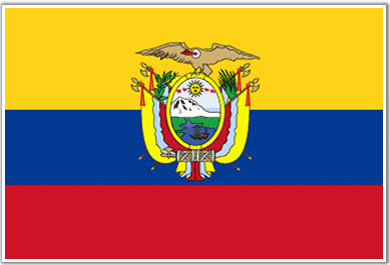
Prior to the arrival of the Spaniards, Ecuador was controlled by the Inca empire. Francisco Pizarro's subordinate, Benalcázar, entered the area in 1533. Not finding the wealth of the mythical El Dorado, he and other conquistadors, notably Gonzalo Pizarro and Orellana, moved restlessly on and the region became a colonial backwater. Given an audiencia in 1563 and established politically as the presidency of Quito, it was at various times subject to Peru and to New Granada. After an abortive independence movement in 1809, the region remained under Spanish control. It was liberated by Antonio José de Sucre in the battle of Pichincha (1822) and was joined by Simón Bolívar to Greater Colombia.

With the dissolution of that union in 1830, Ecuador, geographically isolated, became a separate state (four times its present size) under a constitution promulgated by its first president, Juan José Flores. Ecuador unsuccessfully attempted to annex Popayán prov. from Colombia by war in 1832 and occupied the Galápagos Islands that year. Boundary disputes led to frequent invasions by Peruvians in the 19th and 20th cent. The entire eastern frontier, known as Oriente, was in dispute. (In 1942, Ecuador signed a treaty ceding a large area to Peru, but in 1960 it renounced the treaty.)

Bitter internecine struggles between Conservatives and Liberals marked the political history of Ecuador in the 19th cent. The Conservatives, led by Flores and García Moreno (1821–75), supported entrenched privileges and the dominance of the Roman Catholic Church; the Liberals, led by Rocafuerte (1783–1847) and Alfaro (1867–1912) and championed by the writer Montalvo (1832–89), sought social reforms.

The Twentieth Century

There have been a bewildering number of changes in government during the 20th cent. In 1925 the army replaced the coastal banking interests, dominant since 1916, as the ultimate source of power. Military juntas supported various rival factions, and between 1931 and 1940, 12 presidents were in office. José María Velasco Ibarra became president (for the second time) by a coup in 1944. He was ousted in 1947, and the next year Galo Plaza Lasso was chosen in free elections. During Plaza's regime there was unprecedented political reform. Velasco Ibarra was elected again in 1952 and sponsored improvements in roads and schools.

The first Conservative to rule in 60 years, Camilo Ponce Enríquez, followed (1956–60), but Velasco Ibarra was elected again in 1960. He was forced to resign the following year. His legal successor, Julio Arosemena Monroy, was deposed by a junta in 1963. Agitation for a return to civilian government led the military to remove the junta in 1966. A constitutional assembly installed Otto Arosemena Gómez as provisional president and drafted the country's 17th constitution. Velasco Ibarra was elected for the fifth time in 1968. Two years later, faced with economic problems and protests by leftist students, he assumed absolute power. Velasco promised to hold elections in June, 1972. However, the military deposed him in Feb., 1972, and canceled the elections.

Relations with the United States deteriorated in the early 1970s after Ecuador claimed that its territorial waters extended 200 mi (322 km) out to sea. Several U.S. fishing boats were seized by Ecuadorians, and U.S. aid to the country was suspended. In the same period Ecuador became Latin America's second largest oil producer. After Velasco's ouster, the military governed Ecuador until 1979, when a new constitution came into force and Jaime Roldós Aguilera was elected president. Following his death in 1981, he was succeeded by Osvaldo Hurtado Larrea. Hurtado faced many economic and political problems, including inflation, a large international debt, and a troubled oil industry, but his austerity programs failed to revive the economy.

Contemporary Ecuador

León Febres Cordero Rivadeneira, who replaced Hurtado in 1984, was kidnapped in 1987 by a guerrilla group but was released in exchange for a former coup leader. Rodrigo Borja Cevallos was elected president in 1988, and in 1992 he was replaced by Sixto Durán Ballén. In 1990 the indigenous peoples organized a series of boycotts and demonstrations, known as “the Uprising,” and in 1992 they were given title to a large area of rain forest in the eastern part of the country. That same year Ballén privatized many state-owned enterprises. In 1994 Ecuador reached agreement with creditor banks on a landmark foreign-debt rescheduling plan. Ecuador again clashed with Peru in a border war in 1995; in 1998 the countries signed an agreement finalizing their borders and giving Ecuador access to the Amazon River.

Despite some achievements, Ballén's government was compromised by several developments, including a severe energy crisis and criminal corruption charges against the vice president. New presidential elections, held in mid-1996, resulted in a victory for Abdalá Bucaram, an often flamboyant populist. After only six months in office, he was dismissed for mental incapacity by the congress, which chose its leader, Fábian Alarcón, as interim president, but Vice President Rosalía Arteaga declared herself Bucaram's legitimate successor. An agreement was reached granting Arteaga the position, but she abruptly resigned and Alarcón succeeded her as interim president for 18 months.

Jamil Mahuad Witt, the mayor of Quito, was elected in a presidential runoff in 1998, as the country went into an economic crisis stemming from a drop in oil prices, high inflation, and nearly $3 billion in damages from El Niño. The sucre, the national currency, plunged in 1999, bringing strikes and more economic turmoil, and Mahuad declared a series of states of emergency. In Jan., 2000, dissident military officers and thousands of Ecuadorans of indigenous descent attempted to oust Mahuad and establish a junta, Armed forces chief of staff Gen. Carlos Mendoza intervened and engineered the accession of Vice President Gustavo Noboa Bejarano to the presidency. In Mar., 2000, the congress approved legislation that made the U.S. dollar the national currency beginning in 2001, a move intended to stabilize the economy; it originally had been proposed by Mahuad.

In 2002 the presidential election campaign ended with a runoff victory by Lucio Gutiérrez Borbúa of the leftist January 21st Partriotic Society party. Gutiérrez, a former army colonel, was a leader of the dissident military forces that sparked Mahuad's removal from the presidency in 2000. The government, which had been elected on a promise of increasing social spending, adopted austerity measures to win a new loan from the International Monetary Fund. The move alienated many who had backed Gutiérrez, and made his government dependent on uncertain coalitions in the congress.
A bid to impeach the president (Nov., 2004) failed, and he subsequently won enactment of a reorganization of the supreme court, which he accused of favoring the opposition. That move, however, sparked protests and demonstrations (and counterdemonstrations) and led to a political crisis in early 2005. In April increasing street protests and the president's endorsement of the use of force to quell them led the congress to remove the president. Vice President Alfredo Palacio was sworn in as his successor, and Gutiérrez, who denounced his removal as unconstitutional, went into exile.

In Aug., 2005, protesters in NE Ecuador sparked a national crisis by disrupting the nation's oil industry. They called for more of the revenues to be invested in the Amazonian regions that produce the oil, and won concessions from the government and oil companies. Gutiérrez returned to Ecuador in Oct., 2005, in a bid to retake office, but he was arrested; he was released only in Mar., 2006, after the charges of endangering national security were dismissed.

Palacio, who lacked allies in congress and headed a government suffering from scandal and defections, also was frustrated with his inability to push political reforms through Ecuador's congress. In Oct., 2005, he proposed asking voters to approve holding a constitutional assembly instead, but abandoned the idea (Dec., 2005) after it was rejected by the nation's electoral tribunal. Meanwhile, in November, a new supreme court was finally sworn in. In Feb.–Mar., 2006, the country experienced a new series of demonstrations, by various groups calling for local investment of oil revenues, full-time jobs for oil contract workers, and an end to negotiations on a free-trade pact with the United States. The protests, which disrupted the economy and were sometimes violent, led the government to declare a state of emergency several times during the two months. In the first round of the presidential election in Oct., 2006, no candidate won a majority, forcing a runoff in November. Álvaro Noboa, the country's wealthiest person and a conservative, placed first with 27% of the vote; the runner-up, Rafael Correa, a leftist economist, secured 23%. In the runoff, however, Correa won 57% of the vote.

Correa sought a referendum to establish a national assembly for constitutional reform, which the congress approved in Feb., 2007. The question of the powers of the assembly set off a power struggle between the president (supported by the Supreme Electoral Tribunal), who favored unlimited powers, and the congress, which had approved the assembly with limited powers. A narrow congressional majority voted to remove the tribunal judges aligned with the president, and those judges then voted to remove 57 members of the congress; both moves were of uncertain constitutionality. Correa, buoyed by his popularity and supported by sometimes violent demonstrators, managed to retain the upper hand; the congress lacked a quorum until March, when sufficient substitute members were appointed.

In April, voters approved electing a national assembly to rewrite the constitution, and it was elected in September. Also in April, the consitutional tribunal first refused to hear the congress members' challenge concerning their dismissal and then called for them to be reinstated, but the congress then dismissed the members of the tribunal, and Correa ordered the police to prevent the dismissed members from returning to the congress. In Nov., 2007, the national assembly, dominated by Correa allies, suspended the congress, but a majority of that body subsequently defied that action and met outside the legislature.

A Colombian raid on rebels encamped in Ecuador in Mar., 2008, led to several days of tensions between Colombia and Ecuador, which mobilized troops to the Colombia border and broke diplomatic relations. Colombia said computer files seized in the raid had evidence of monetary support for Correa from the rebels. Colombia subsequently apologized for the raid, which the Organization of American states called a violation of Ecuadorian sovereignty and the OAS charter. Relations between Ecuador and Colombia, however, continued to be strained. The raid also led to the resignation of the leaders of Ecuador's armed forces after it was learned that Ecuadoran intelligence services had shared information about the rebels with Colombia but not alerted the presidency to it.

Ecuador History

Saturday, January 5, 2013

History to the Twentieth Century

The history of the country has been unusually turbulent and has been closely linked with that of the neighboring republic of Haiti. After Spain by the Treaty of Basel (1795) ceded the colony of Santo Domingo to France, the area now known as the Dominican Republic was conquered by Haitians under Toussaint L'Ouverture. Toussaint was defeated by the French, who invaded Haiti under General Leclerc. The resident French commander was able to fend off the attacks of Jean Jacques Dessalines, but in 1808 the people revolted and in 1809, with the aid of an English squadron, ended French control of the city of Santo Domingo. Spanish rule was reestablished.
In 1821 the inhabitants expelled the Spanish governor, but in 1822 they were reconquered by the Haitians under Jean Pierre Boyer. A revolt broke out in 1844, the Haitians were defeated, a constitution was promulgated, and a republic was established under Pedro Santana. Frequent revolts as well as continued Haitian attacks led Santana to make his country a province of Spain in 1861, but opposition under Buenaventura Báez was so severe that Spain withdrew in 1865.
Unable to preserve order, Báez himself negotiated a treaty of annexation with the United States, which the Dominicans approved but which the U.S. Senate failed to ratify. All semblance of order vanished. There were kaleidoscopic changes in the presidency and a long (1882–99), ruthless dictatorship under Ulíses Heureaux, ended by his assassination and followed by more revolutions.

The Early Twentieth Century

The republic was hopelessly bankrupt by 1905 and faced intervention by European powers. U.S. President Theodore Roosevelt arranged a U.S. customs receivership. Although there was a marked improvement in finances, fiscal control brought virtual political domination by the United States. Disorder continued, however, and the country was occupied by U.S. marines in 1916. They were withdrawn in 1924 and the customs receivership terminated in 1941.
After the overthrow of Horacio Vásquez in 1930, Rafael Trujillo Molina became dictator. Border clashes with Haiti occurred, and in 1937, Dominican troops massacred thousands of immigrant Haitians. War was narrowly averted. Trujillo suppressed domestic opposition, and he and his retinue gradually turned the country into a private fiefdom. Material improvements in roads, agriculture, sanitation, and education contributed to the prolongation of the regime. Feuds with other Caribbean nations developed. In 1961, Trujillo was assassinated.

The Balaguer-Bosch Era

Joaquín Balaguer, who had been named president by Trujillo in 1960, initiated democratization measures and withstood attempts by the Trujillo family to regain power. Balaguer was deposed (Jan., 1962), but the governing council, after surviving a military coup, promulgated (Sept., 1962) a new constitution. In Dec., 1962, in their first free election since 1924, the Dominicans elected Juan Bosch president by a substantial majority. Bosch committed himself to an ambitious program of reforms, but right-wing opposition led to his overthrow in Sept., 1963. A civilian triumvirate was installed by the military leaders, and Donald Reid Cabral emerged as its chief member.

In 1965 civil war broke out again after military supporters of Bosch toppled the government. A cease-fire was negotiated by the Organization of American States (OAS) and in 1965 a compromise agreement was reached. In 1966, with Bosch and Balaguer the leading candidates, an election was held. Balaguer, the Social Christian Reform party (PRSC) candidate, won and took office on July 1. The authoritarianism of the Trujillo period continued under Balaguer, who enjoyed the support of the right, the military, and the Church.

Balaguer was reelected in 1970 and 1974. The political climate, however, remained uneasy, with the economy stagnant, and from 1978 to 1986 the Dominican Revolutionary party (PRD) held power. Rising prices resulting from a program of economic austerity cost the PRD its ruling position, and the aging Balaguer again won the presidency in 1986, in 1990, and (for a two-year term) in 1994, but he was barred from running again 1996.

Elections in 1996 led to a runoff that was won by the Dominican Liberation party (PLD) candidate, Leonel Fernández Reyna. A protégé of Bosch, Fernández was a lawyer who had been raised in New York City and had not previously held political office. Although the country enjoyed steady economic growth under Fernández, farmers and poorer Dominicans saw little improvement in their well-being, and his term was marred by corruption scandals.

In 2000, Hipólito Mejía Dominguez, an agronomist and businessman who was the PRD candidate, won the presidential election; he promised to aid those who had not benefited from the years of growth. The economy worsened, however, under Mejía, and he failed to win a second term in 2004, as voters elected his predecessor, Leonel Fernández, to the presidency. Also in 2004 the country agreed to join in a free-trade area with the United States and most Central American nations. Improved economic conditions benefited Fernández's PLD in 2006, when the party secured a majority in the congressional elections, and Ferńndez himself was reelected in 2008.

Dominican Republic History

Tuesday, January 1, 2013

Dominica (dominē'ku) [key], officially Commonwealth of Dominica, republic (2005 est. pop. 69,000) consisting of the island of Dominica (290 sq mi/750 sq km), located in the Windward Islands, West Indies. Roseau is the capital and chief port. The island, of volcanic origin, is mountainous and forested, with a wide variety of flora and fauna and an extensive national park system. Dominica is subject to frequent destructive hurricanes. The population is largely of African or mixed European and African descent. More than three quarters of the inhabitants are Roman Catholics, the balance mainly Protestants. English is the official language, but a French patois is also widely spoken.

Bananas are the chief commercial crop and export. Citrus, coconuts, and coconut oil are also exported, and mangoes and root crops are raised. Industry is generally limited to food processing and the manufacture of soap and other coconut-based products. Tourism is a growing industry, but Dominica remains one of the poorer Caribbean nations. The main trading partners are Great Britain, the United States, and China.

Dominica History

Saturday, December 29, 2012

France first obtained a foothold in the region in 1862. French interest centered around Djibouti, the French commercial rival to Aden. By 1896 it was organized as a colony and in 1946 it became a territory within the French Union. Membership in the French Community followed in 1958. The political status of the territory was determined by a referendum in 1967, in which the Afar population, until then the group that had the lesser voice in government, gained political ascendancy with French support. The Afars opted for a continuation of the connection with France, whereas the Somalis voted for independence and eventual union with Somalia.

France officially recognized Djibouti's independence in 1977. In the three years that followed, the Afar and Issa-Somali communities struggled to obtain control over the government. In 1979, efforts were made to unite the two ethnic groups through the formation of the People's Progress Assembly (RPP). In 1981, Hassan Gouled Aptidon, president since independence, established the RPP as the only legal political party in the country.

Despite its attempts at peacemaking, Djibouti has been adversely affected by warfare in and between neighboring Ethiopia and Somalia. Moreover, beginning in 1991, tensions between Afars and the Issa-dominated government resulted in an Afar rebellion. A reconciliation agreement was reached in 1994, but the last remaining rebel group signed a peace accord only in 2001. There also were border clashes with Eritrea during the mid-1990s. Djibouti was the base of operations for French forces during the Persian Gulf War, and the French remain a strong military and technical presence. The United States also established a military presence in the nation beginning in 2002.

In 1992 a constitution allowing for a limited multiparty state was approved by Djibouti's voters. In 1993, Gouled was reelected in the country's first multiparty elections, which were widely boycotted by the opposition. The 1999 presidential election was won by Ismail Omar Guelleh, the governing party candidate (and a nephew of Gouled). In 2003 the government sought to expel an estimated 100,000 illegal immigrants, largely Ethiopians and Somalis, from the country. The move was prompted by security and unemployment concerns. Guelleh was reelected in 2005, but the opposition refused to contest the election, believing that the government would rig the vote. In July, 2008, fighting erupted briefly between Djibouti and Eritrea near the Bab el Mandeb; Djibouti had accused Eritrea of occupying Djiboutian territory there earlier in the year.

Djibouti History

Thursday, December 27, 2012

Ancient History to 1448

The Danes probably settled Jutland by c.10,000 B.C. and later (2d millennium B.C.) developed a Bronze Age culture there. However, little is known of Danish history before the age of the Vikings (9th–11th cent. A.D.), when the Danes had an important role in the Viking (or Norse) raids on Western Europe and were prominent among the invaders of England who were opposed by King Alfred (reigned 871–99) and his successors. St. Ansgar (801–65) helped convert the Danes to Christianity; Harold Bluetooth (d. c.985) was the first Christian king of Denmark. His son, Sweyn (reigned c.986–1014), conquered England. From 1018 to 1035, Denmark, England, and Norway were united under King Canute (Knut). The southern part of Sweden (Skåne, Halland, and Blekinge) was, with brief interruptions, part of Denmark until 1658.

After Canute's death, Denmark fell into a period of turmoil and civil war. Later, Waldemar I (reigned 1157–82) and Waldemar II (reigned 1202–41) were energetic rulers who established Danish hegemony over N Europe. With the end of the Viking raids and the development of a strong and independent church, the nobles were able to impose their will on the weaker kings. In 1282, Eric V (reigned 1259–86) was forced to submit to the Great Charter, which established annual parliaments and a council of nobles who shared the king's power. This form of government persisted until 1660.

Waldemar IV (reigned 1340–75) again brought Danish power to a high point, but he was humiliated by the Hanseatic League in the Treaty of Stralsund (1370). Waldemar's daughter, Queen Margaret, achieved (1397) the union of the Danish, Norwegian, and Swedish crowns in her person (see Kalmar Union). Sweden soon escaped effective Danish rule, and with the accession (1523) of Gustavus I of Sweden the union was dissolved. However, the union with Norway lasted until 1814.

Denmark and Norway

In 1448, Christian I became king and established on the Danish throne the house of Oldenburg, from which the present ruling family (Schleswig-Holstein-Sonderburg-Glücksburg) is descended. He also united (1460) Schleswig and Holstein with the Danish crown. The Reformation (early 16th cent.) gradually gained adherents in Denmark, and during the reign of Christian III (1534–59) Lutheranism became the established religion. In the late 16th and early 17th cent., Denmark had a brilliant court, with a brisk intellectual and cultural life; the astronomer Tycho Brahe (1546–1601) was a major figure, and the Danish Renaissance style of architecture (strongly influenced by that of the Low Countries) was developed.

The division of power in Denmark between the king and the nobles seriously handicapped the country's attempt to gain supremacy in the Baltic region. Denmark was involved in numerous wars with Sweden and other neighbors; the participation of Christian IV (reigned 1588–1648) in the Thirty Years War (1618–48) and the wars of Frederick III (reigned 1648–70) with Sweden caused Denmark to lose its hegemony in the north to Sweden. The Danish-Swedish Treaty of Copenhagen (1660) confirmed most of the Danish losses imposed by the Treaty of Roskilde (1658).

The wars weakened the nobility by reducing its numbers and strengthened the monarchy by increasing the power and importance of the royal army. Frederick III and Christian V (reigned 1670–99), aided by their minister Count Griffenfeld, were able to make the kingdom an absolute monarchy with the support of the peasants and townspeople. Denmark maintained an imperial status by continuing to rule over Iceland and by establishing (late 17th cent.) the Danish West Indies (see Virgin Islands). In the Northern War (1720–21) against Charles XII of Sweden, Frederick IV (reigned 1699–1730) gained some financial awards and the union of ducal Schleswig with royal Schleswig.
The later 18th cent. was marked by important social reforms carried out by the ministers Johann Hartwig Ernst Bernstorff, Andreas Peter Bernstorff, and Johann Friedrich Struensee. Serfdom was abolished (1788), and peasant proprietorship was encouraged. In the French Revolutionary and Napoleonic Wars, Denmark, having sided with Napoleon I, was twice attacked by England (see Copenhagen, battle of; Copenhagen). By the Treaty of Kiel (1814), Denmark lost Norway to Sweden and Helgoland to England, but retained possession of Greenland, the Faeroe Islands, and Iceland.

1814 to the Present

In the early 19th cent., Denmark's modern system of public education was started, and there was a flowering of literature and philosophy (led by Hans Christian Andersen and Søren Kierkegaard). As a result of plans for a liberal, centralized constitution, Frederick VII (reigned 1848–63) became involved in a war with Prussia (1848–50) over the status of Schleswig-Holstein. Denmark was defeated and agreed in the London Protocol of 1852 to preserve a special status for the two duchies. In the meantime, a new constitution was promulgated (1849), ending the absolute monarchy and establishing wide suffrage.

The new government attempted (1855) to incorporate Schleswig into the Danish constitutional system, and soon after the accession (1863) of Christian IX war broke out again (1864), this time with Prussia and Austria. Denmark was defeated badly and lost Schleswig-Holstein. This loss of about one third of the Danish territory was, however, offset by great economic gains that transformed Denmark, in the second half of the 19th cent., from a land of poor peasants into the nation with the most prosperous small farmers in Europe. This change was achieved largely by persuading the farmers to specialize in dairy and pork products rather than in grain (which was more expensive to produce than the grain imported from the United States). The folk high schools, originated by N. F. S. Grundtvig (1783–1872), played an important role in reeducating the Danish farmers. At the same time, the cooperative movement flourished in Denmark. Electoral reforms (1914–15) granted suffrage to the lower classes and to women and strengthened the lower chamber of the legislature.

Denmark remained neutral in World War I and recovered North Schleswig after a plebiscite in 1920. 
In the interwar period and after World War II, Denmark adopted much social welfare legislation and a system of progressive taxation. Although the Social Democratic government of Denmark had signed a 10-year nonaggression pact with Germany in 1939, the country was occupied by German forces in Apr., 1940. Christian X (reigned 1912–47) and his government remained, but in Aug., 1943, the Germans established martial law, arrested the government, and placed the king under house arrest.

Most of the Jewish population (including refugees from other countries) escaped, with Danish help, to Sweden. Among the escapees was Neils Bohr, the Danish physicist who went on to the United States and worked on the atomic bomb project at Los Alamos. The Danish minister in Washington, although disavowed by his government, signed an agreement granting the United States military bases in Greenland. Danish merchant vessels served under the Allies, and a Danish resistance force operated (1945) under the supreme Allied command. Denmark was liberated by British troops in May, 1945. After the war, Denmark recovered quickly, and its economy, especially the manufacturing sector, expanded considerably.

Denmark became (1945) a charter member of the United Nations and, breaking a long tradition of neutrality, joined the North Atlantic Treaty Organization in 1949. Frederick IX became king in 1947. In 1960, Denmark became part of the European Free Trade Association, which it left in 1972 in order to join the European Community (now the European Union). Denmark granted independence to Iceland in 1944 and home rule to the Faeroe Islands in 1948 and to Greenland in 1979. Frederick IX died in 1972 and was succeeded by Margaret II. In 1982, the first Conservative-led government since 1894, a center-right coalition headed by Poul Schlüter, came to power.

Having initially rejected (June, 1992) the European Community's Maastricht Treaty, an agreement that represented a major step toward European unification, Danish voters approved the treaty with exemptions in May, 1993. In 1993, Schlüter resigned; Poul Nyrup Rasmussen, a Social Democrat, became prime minister, heading a center-left coalition that was returned to office in 1998. In a blow to Rasmussen, Danish voters rejected adoption of the euro (see European Monetary System) in a referendum in Sept., 2000. Parliamentary elections in 2001 brought a Liberal party–led conservative coalition to power, and Anders Fogh Rasmussen became prime minister in the minority government. The government remained in office after the 2005 elections.

The publication of cartoons with images of the Prophet Muhammad in a Danish newspaper in Sept., 2005, brought protests from Danish Muslims and ambassadors from Muslim nations, because of Islamic prohibitions on any representation of Muhammad. The protests initially drew tepid responses from the newspaper and Danish officials. The subsequent distributione by Muslim clerics of the cartoons combined with even more offensive images, and the republication of the original cartoons in some other Western and non-Western papers, sparked sometimes violent anti-Danish and anti-Western protests and boycotts of Danish goods in many Muslim nations in early 2006 and led to apologies for causing offense from the newspaper and Denmark. After snap parliamentary elections in Nov., 2007, the Liberal-led government remained in office.

Denmark History

flag meaning and history

flag pictures

country history